How to Solve Hard Water Problems in High-Rise Apartments—Without Rebuilding Your Plumbing
You move into a brand new and beautiful apartment. The bathroom fittings shine, the glasses looks spotless, and the geyser works perfectly fine.
A few months later, white scale covers all your taps and tiles. The shower flow feels weaker. Your skin feels dry, your hair feels rough, and non of the bathroom cleaner keeps the stains away.
The apartment is new. So, what is wrong?
Congratulations, It is your hard water.
This is a common concern in high-rise apartments across Noida, Greater Noida, Ghaziabad, Faridabad, Gurgaon, and other parts of Delhi NCR. The good news? You don’t need to change your apartment’s entire plumbing to solve it.
Why Do High-Rise Apartments Get Hard Water?
Maximum residential societies in Delhi, NCR receive water from a combination of municipal supply, borewells and tankers. This water may be mixed in underground or overhead tanks before reaching to your flats.
As groundwater passes through many layers of rocks and soil, it contains access calcium and magnesium. Higher concentrations of these minerals make the water hard.
For reference, the Bureau of Indian Standards lists 200 mg/L as the acceptable limit for total hardness in drinking water and 600 mg/L as the permissible limit when an alternative source is unavailable. Government water-quality data confirms these limits.
Reference- https://www.pib.gov.in/Pressreleaseshare.aspx?PRID=1843385
However, hardness can vary between societies, even between towers—and sometimes even at different supply timings. That is why your neighbor's water report may not as same as your water reaching your bathroom.
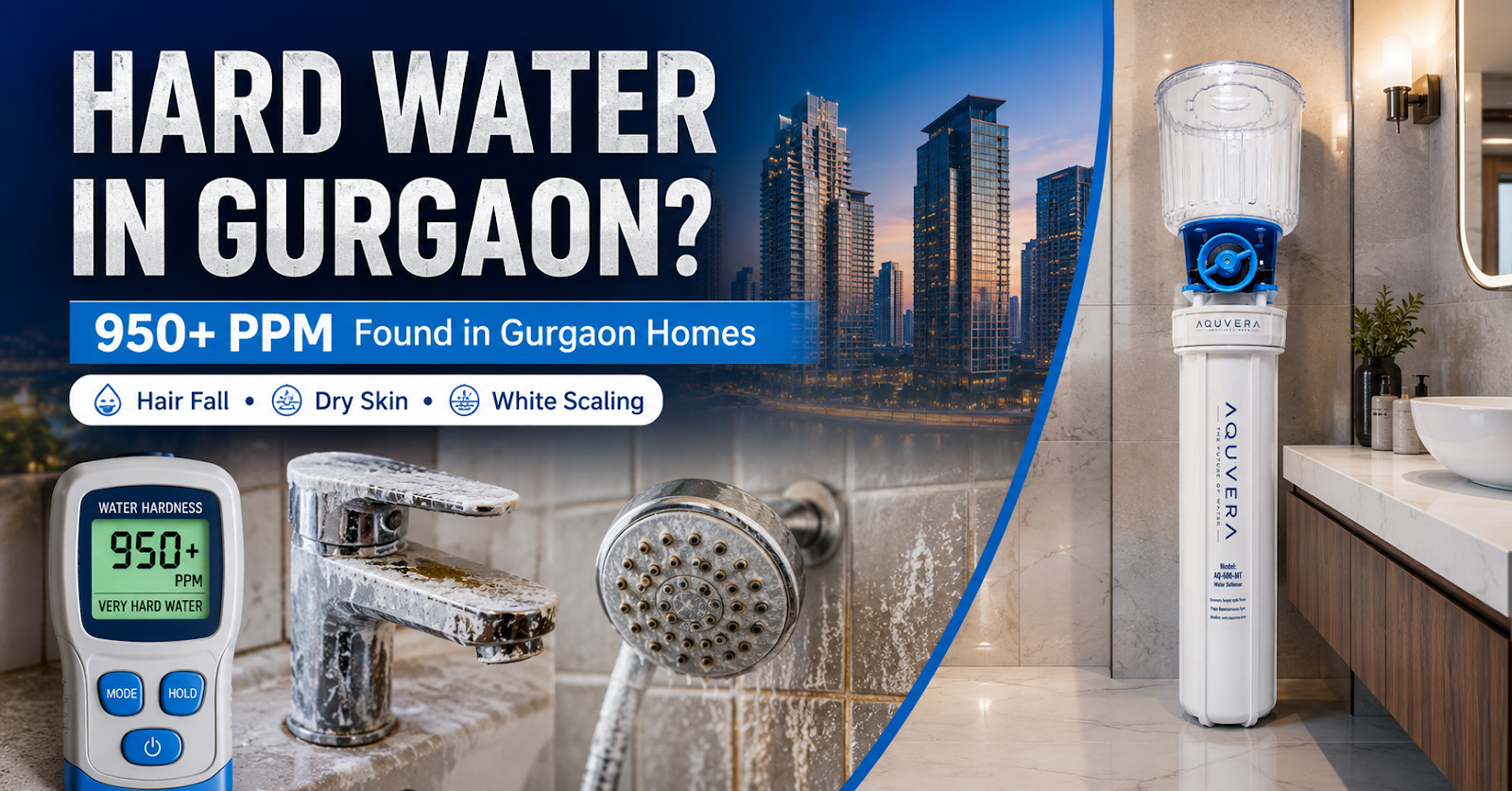
Signs Your Apartment Has Hard Water
⚪ White scaling on taps, tiles and showers
🧼 Soap and shampoo not generating proper leather
🖐️ Dry or itchy skin after bath
💇♀️ Rough, dull or tangled hair
👕 Dull clothes after washing
⚙️ Frequent scaling in geysers and washing-machine inlets
💧 Reduced your water flow
If any of these signs seem familiar to you, read about the five common signs of hard water.
https://www.theaquvera.com/blog-post.php?post=5-signs-hard-water
The Right Way to Solve Hard Water in an Apartment
1. Test the Water at Your Tap
Start with a proper water hardness test—not just a TDS reading.
A TDS meter measures all dissolved substances in water. It cannot tell you exactly how much calcium and magnesium are present in your water. A hardness test gives you the proper information needed that helps you to choose the correct softener capacity.
If your society switches between borewell and municipal water, testing at different supply times may give a more accurate picture.
2. Decide How Much Water You Want to Treat
High-rise residents generally have three options:
Single-bathroom water softener:
This is often the simplest option for an individual flat. It treats water when entering one bathroom and helps with bathing and scaling-related concerns on taps and tiles, and geyser protection. Installation usually requires minimum space and minor plumbing changes.
Whole-flat water softener:
If the apartment has a single incoming line connecting all bathrooms, one softener can treat water supplied to multiple bathrooms and appliances. It must be selected carefully according to water pressure, flow rate, family size and daily consumption.
Central society water softener:
A large centralized system can treat water for an entire tower or society. This requires an RWA decision, technical planning, adequate plant space and regular maintenance.
For most families who want a solution without waiting for society-wide approval, a properly sized bathroom softener is the most practical starting point.
3. Choose Technology That Actually Reduces Hardness
A sediment filter can remove visible sand or rust, but it cannot remove hardness minerals. Similarly, a kitchen RO treats drinking water at one point; it does not soften water reaching your shower, geyser or washing machine.
A genuine water softener uses ion-exchange technology to reduce calcium and magnesium from water. You can learn how ion-exchange water softeners work.
https://www.theaquvera.com/blog-post.php?post=ion-exchange-explained
4. Check These High-Rise Installation Details
Before selecting a water softener for an apartment, confirm:
- Available installation space
- Water pressure and required flow rate
- Pipe and inlet-outlet size
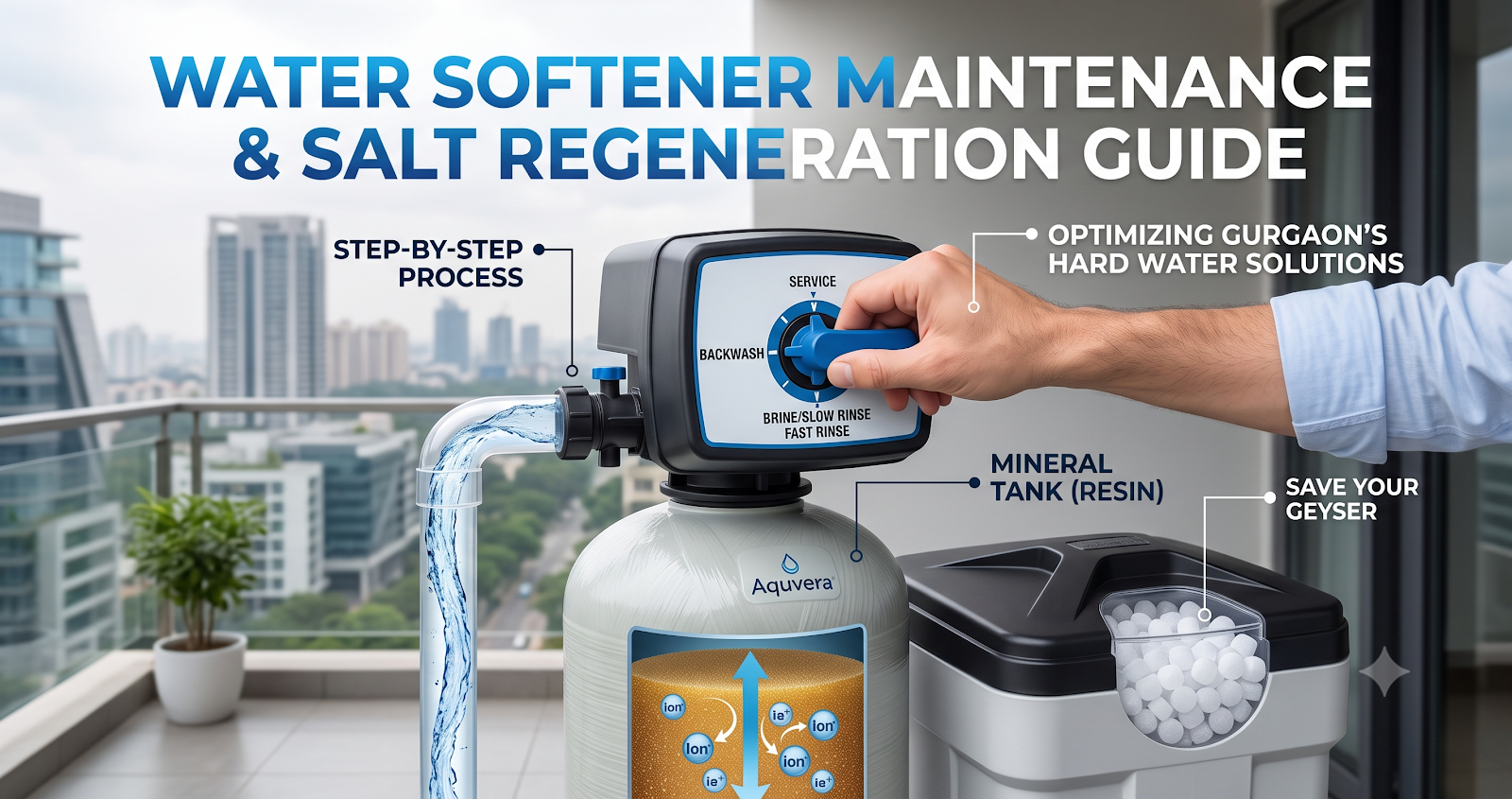
- Easy access for adding salt into softener
- Bypass provision for servicing
- Actual daily water consumption
- Actual water hardness instead of TDS
Choosing only by price or resin capacity can result in weak water flow, frequent regeneration or poor performance.
Is a Water Softener Really Necessary?
If hard water is only leaving an occasional spot, regular cleaning may be enough.
But when scale keeps returning, shampoo usage increases, skin feels rough and appliances like geyser, washing machine require frequent servicing, treating the water becomes more practical than repeatedly treating the appliances.
A correctly selected softener can mean better lather, easier cleaning, reduced scale and improved protection for geysers, taps, showerheads and washing machines.
Frequently Asked Questions
Can a water softener be installed inside an apartment?
Yes. A compact bathroom softener is designed to be installed near the bathroom inlet, geyser line or another suitable point. Plumbing access and available space must be checked first.
Will a water softener reduce TDS?
Not necessarily. A softener is designed to reduce hardness-causing calcium and magnesium. TDS and hardness are related measurements, but they are not the same thing. Sometimes TDS may increases a bit after water softener.
Do I need RWA permission?
No, Installation entirely inside your flat may not require any permission. Permission may be needed if common pipelines, external shafts or shared areas are involved. Check your society rules and regulations.
Which softener capacity should I choose?
Capacity depends on measured hardness, your daily water usage, water flow rate and the number of people using the bathroom. Test the water before choosing a model.
Start With a Water Test, Not a Product
Aquvera provides you a completely free at-home water hardness testing, and expert guidance across Noida, Greater Noida, Ghaziabad, Gurgaon, Faridabad and Delhi NCR.
Your water is tested first. The appropriate bathroom or whole-house water softener solution is then recommended according to your actual water hardness, water pressure and family usage.
🧪 Book Your Free Water Hardness Test now!
📲 Call or WhatsApp: 8076676871 | 8287687567
🌐 Visit: www.theaquvera.com and compare all the available Water Softener sizes and their specifications.
💬 Comments 0
Leave a Comment
Your email will not be published. Fields marked * are required.